








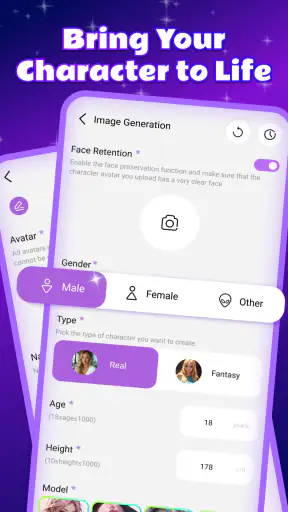
Star Girl:Cosmic Conversations caught my attention because it combines two ideas that usually live in separate apps: an AI role-playing chat and a card-unlocking adventure. After spending time with it, I found the appeal easy to understand. It is designed for short, character-focused sessions rather than a traditional game with a large map, complicated combat, or a long list of objectives. You open it when you want to talk, explore a scenario, and see what the next exchange brings.
That simplicity is both its strongest quality and its biggest question mark. The first sessions feel fresh because the conversation gives the experience a personal rhythm, while the card element adds a reason to keep exploring. The harder question is whether that loop remains interesting after the novelty of meeting the characters wears off. My answer is qualified: this is a pleasant entertainment app for people who enjoy imaginative chat and collectible progress, but it is not automatically a lasting daily habit for everyone.
What the first week feels like
The opening appeal comes from the low barrier to entry. You do not need to learn a conventional control scheme or understand a complicated ruleset before enjoying the app. The main activity is conversational, so the experience feels closer to interactive fiction than to a typical mobile game. I could approach it casually, write a few messages, and leave without feeling that I had failed a mission or wasted a long play session.
The role-playing angle matters here. A normal chatbot can feel like a blank utility, while a standard entertainment app often gives you a fixed script. Star Girl:Cosmic Conversations sits between those formats. The character framing encourages me to respond in a particular mood and imagine a setting, but the chat still leaves room for my own choices. That makes the first few conversations feel more personal than simply tapping through prewritten dialogue.
The card-unlocking side gives those conversations a visible sense of progress. Instead of treating every exchange as disposable, the app connects the experience to discovery. I found that useful during the first week because it gave me a small target when I was unsure what to do next. The cards are not just decoration in my mind; they help turn an open-ended chat into something that feels like an adventure with pieces to uncover.
Still, I would not describe the first week as a deep game campaign. The pleasure is in the atmosphere, the character interaction, and the anticipation of discovering more. Anyone expecting strategic battles, elaborate puzzles, or a large story with tightly controlled scenes may feel that the app is lighter than its adventure language suggests. It works best when I treat it as an interactive entertainment companion rather than a replacement for a full role-playing game.
One practical strength is how naturally it fits into small gaps in the day. I can imagine using it during a quiet coffee break, before bed, or while waiting for an appointment. A short exchange can feel complete enough on its own, and I do not have to reserve an entire evening for it. That makes the app more approachable than story games that punish interruptions or require me to remember a complex plot every time I return.
The first-week experience also reveals an important personal preference. If I enjoy inventing replies, testing different tones, and treating a character as part of a fictional scenario, the app quickly becomes engaging. If I prefer polished voice acting, cinematic presentation, or carefully authored dialogue, the conversational format may feel too open. The quality of the experience depends heavily on how much imagination I bring to the exchange.
Cards make the chat feel less disposable
The card system is the feature that separates this app from a basic character-chat tool. It gives me a collection-oriented reason to revisit conversations rather than stopping after one interesting exchange. That creates a gentle loop: interact, discover, and return to see what else can be unlocked. The loop is easy to understand, which is helpful for casual users who do not want a dense tutorial.
My advice is to avoid rushing through the unlocking side simply because a new card is available. The more enjoyable approach is to treat cards as milestones attached to the role-playing experience, not as the only reason to use the app. When I focus exclusively on collecting, the conversations risk becoming a means to an end. When I let the character interaction lead, the cards add a satisfying layer instead of turning the app into a repetitive checklist.
That distinction is one of the less obvious trade-offs. Collection mechanics can extend an app’s life, but they can also expose how limited the underlying activity feels. If every return visit is motivated only by the next unlock, the sense of discovery may fade quickly. The app is at its best when the conversation itself remains enjoyable even before a new card appears.
What remains after the novelty fades
After the first month, the central issue is recurring value. A new app can feel exciting simply because everything is unfamiliar. With Star Girl:Cosmic Conversations, long-term interest depends on whether I still want to step into the role-playing setting after I already understand its basic rhythm. The card collection helps, but it cannot carry the whole experience if the chats begin to feel interchangeable.
I see the strongest month-to-month use case in mood-based entertainment. Some days I want a light fictional conversation without committing to a novel or a full game. On those days, the app can be a comfortable choice. It gives me a small imaginative break and lets me decide how much effort to put into the interaction. That flexibility is more valuable than a rigid daily reward structure for users who do not want another demanding routine.
It is also suitable for people who enjoy experimenting with role-play prompts. I can approach the same character interaction with a playful tone, a serious question, or a story-building mindset. The useful trick is to give the conversation a purpose before opening it. For example, I might decide to continue a scene, test a character reaction, or create a short fictional problem to solve. That makes a session feel more deliberate than sending random messages until the novelty disappears.
On the other hand, users who want a clearly authored story may eventually miss stronger direction. Open conversation offers freedom, but freedom can also reduce narrative momentum. A traditional visual novel or story-driven game usually tells me what the next dramatic beat is and builds toward it. Here, I have more responsibility for creating the shape of the experience. That is liberating for some people and tiring for others.
The app’s audience numbers suggest that it has found a substantial group of interested users, with over a million installs and an average rating of 4.6 from around twenty-three thousand ratings. I read that as evidence of broad appeal, not proof that every user will find lasting value. Entertainment apps often receive enthusiastic early reactions because the concept is immediately understandable. The more useful question for me is whether my own preferred style of interaction matches the design.
Star Girl:Cosmic Conversations is free to start, which makes experimenting with it straightforward. There are in-app purchases ranging from $3.49 to $104.99 per item, so I would set a personal spending limit before becoming invested in the collection. The presence of optional purchases does not automatically make the experience unsuitable, but it changes how I would approach the card loop. I would enjoy the free experience first and only consider paying if the app had already earned a regular place in my routine.
This is especially important for anyone who is motivated by completion. Collectible progress can create a subtle pressure to unlock everything, even when the entertainment value is no longer keeping pace. My practical rule would be simple: do not buy an item merely to overcome impatience with a loop you have stopped enjoying. If the conversations are still fun, a purchase may feel like support for that enjoyment. If they are not, spending more is unlikely to solve the underlying problem.
The maintenance cost is small, but not zero
Compared with a large online game, the maintenance burden feels modest. I do not need to memorize a complicated build, manage a large inventory, or keep up with a competitive schedule. That is a real advantage for an entertainment app intended for relaxed use. The current version is 2.2.6, and the app runs on Android 7.0 or later, which also makes it accessible to people using older supported devices.
Even so, “low maintenance” does not mean effortless forever. I still need to decide when the app deserves my attention, how much time I want to spend chatting, and whether collecting cards is enhancing the experience or replacing it. The maintenance is psychological rather than technical: keeping the activity fresh requires me to bring new prompts, scenarios, or expectations to it.
I found that a light schedule works better than forcing daily use. Returning only when I genuinely want a fictional conversation protects the app from becoming another obligation. This is a useful distinction from games built around streaks or timed events. If I turn every session into a duty, the conversational freedom that attracted me in the first place starts to feel like work.
For families, the age label deserves attention. The app is rated Mature 17+, so I would not treat it as general family entertainment or hand it to a younger teenager without considering that rating. Adults who are comfortable with mature-themed entertainment may find the format appealing, but the age guidance should be part of the decision before installation, especially on a shared device.
Privacy-minded users may also want to think carefully about their own chat habits. Even without turning the app into a personal diary, I would avoid entering sensitive information, private identifiers, or details I would not want associated with an entertainment service. That is a sensible habit for any conversational app, but it matters more here because the interaction invites personal, informal replies.
Where fatigue starts to appear
The first source of fatigue is repetition. A conversational format can feel varied when I am actively shaping it, but the illusion of novelty weakens if my sessions follow the same pattern every time. The card loop may delay that feeling, yet it cannot remove it completely. I noticed that the app is more enjoyable when I change my approach rather than expecting the system alone to provide endless surprises.
The second source is the uneven effort required from the user. In a conventional game, the world, objectives, and pacing do much of the work. Here, I may need to supply the imagination that keeps a scene moving. That is not a flaw for role-playing fans, but it is a genuine cost. If I am tired and want passive entertainment, a show, podcast, or authored story may serve me better.
The third is the tension between collecting and conversation. Cards provide a reason to continue, but the pursuit can make the experience feel transactional if I focus too strongly on progress. I would recommend paying attention to that feeling. When I start skipping the actual role-play to reach the next collectible, the app is no longer delivering its strongest feature.
There is also a difference between emotional engagement and narrative depth. I can enjoy a charming exchange without believing that the app offers the same carefully developed arc as a book or a story-heavy game. That distinction helped me judge it more fairly. It is good at creating a small interactive moment; it is less convincing if I demand a fully structured saga that carries itself without my input.
Who should make room for it?
I would recommend Star Girl:Cosmic Conversations to adults who enjoy AI role-playing chat, character interaction, and light collection mechanics. It is particularly suitable for someone who wants entertainment in short sessions and likes adding their own ideas to a fictional exchange. The free entry point makes it easy to test, while the card system gives the experience more shape than an ordinary chat app.
I would be more cautious about recommending it to someone who wants a deep, traditional adventure. If your ideal game includes tactical decisions, exploration, precise objectives, or a long authored campaign, this may feel too dependent on conversation. A visual novel, role-playing game, or interactive story would probably be a better choice for that preference.
It is also not the right fit for people who dislike open-ended interaction. Some users want an app to entertain them with minimal participation. This one asks me to contribute, and the quality of a session often improves when I provide a clear direction. That can be rewarding, but it means the app is not equally satisfying on every mood or every day.
For someone deciding whether to pay, I would use a simple test over several sessions. First, see whether you return because you want another conversation, not only because an unlock is available. Next, check whether the card progress adds enjoyment rather than pressure. Finally, decide whether the app still feels worthwhile when you use it briefly. If the answer is yes, spending cautiously may make sense; if not, the free version has already answered the question.
Developer Akeynan Apps has positioned this as an entertainment experience rather than a productivity tool, and that is exactly how I would use it. I would not expect it to improve my schedule, replace social contact, or become a serious storytelling workspace. Its value is smaller and more immediate: a fictional conversation, a little discovery, and a break from more demanding forms of screen time.
One everyday scenario captures its best use. Imagine finishing work with twenty quiet minutes before dinner. I might open the app, continue a playful scenario, and aim to uncover one more card without committing to a full game session. If the exchange feels lively, the time passes pleasantly. If I am too tired to invent replies, I can close it quickly and choose something more passive. That flexibility is why I see it as a useful optional habit rather than a must-use app.
In the long term, the app earns space only when the conversation remains enjoyable without the promise of a new unlock. That is the standard I would apply after the initial excitement. The cards are a good supporting idea, but they should not be the sole reason to return. The strongest users will be those who like creating scenarios and are comfortable with a lighter, less structured kind of adventure.
My final view is positive but measured. Star Girl:Cosmic Conversations is a distinctive free entertainment app with an inviting first-week experience, accessible short sessions, and a collection layer that gives AI role-playing chat more direction. Its limitations become clearer over time: repetition can set in, the user must supply much of the creative energy, and purchases can make completion feel more urgent than the underlying fun deserves.
I would keep it installed if I wanted an occasional imaginative break and enjoyed treating chat as a small role-playing space. I would skip it if I needed a deep campaign, passive viewing, or a tightly authored story. For the right person, it can remain a pleasant recurring companion after the novelty fades, but it works best as a flexible choice in an entertainment rotation, not as a commitment that must fill every day.


